


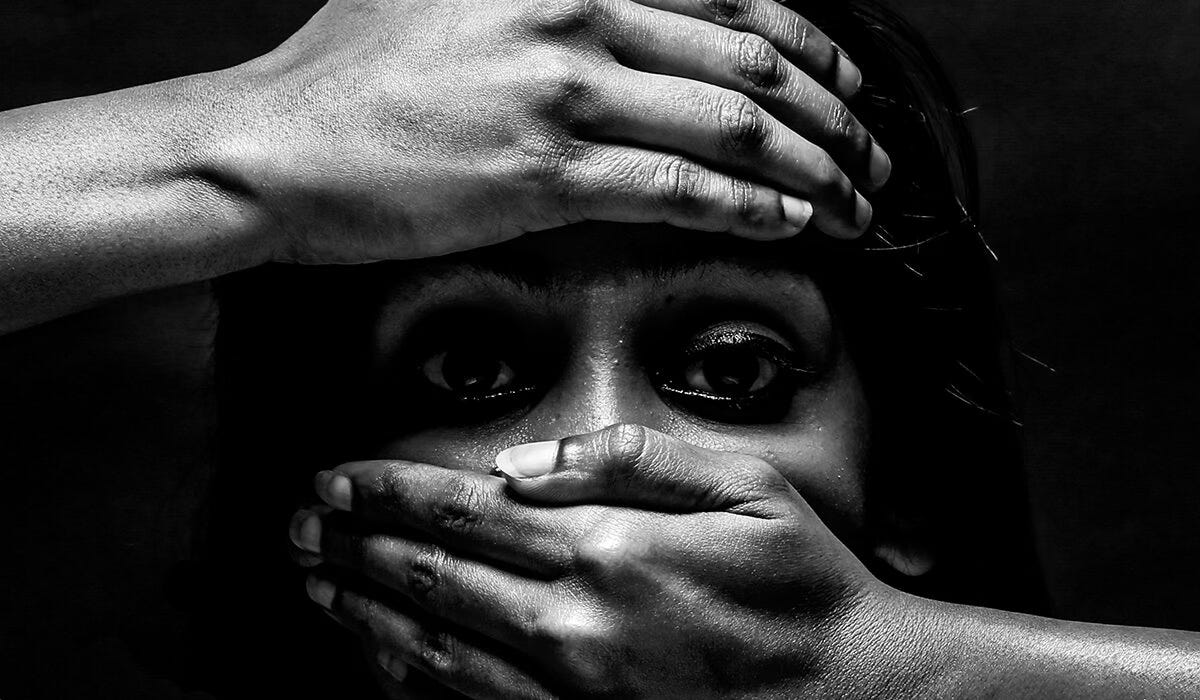
When accountability is deferred, failure doesn’t disappear. It accumulates. Like a water leak behind a wall. Small problems that could have been addressed early compound into crises. And by the time attention is forced, the damage is broader and much deeper.
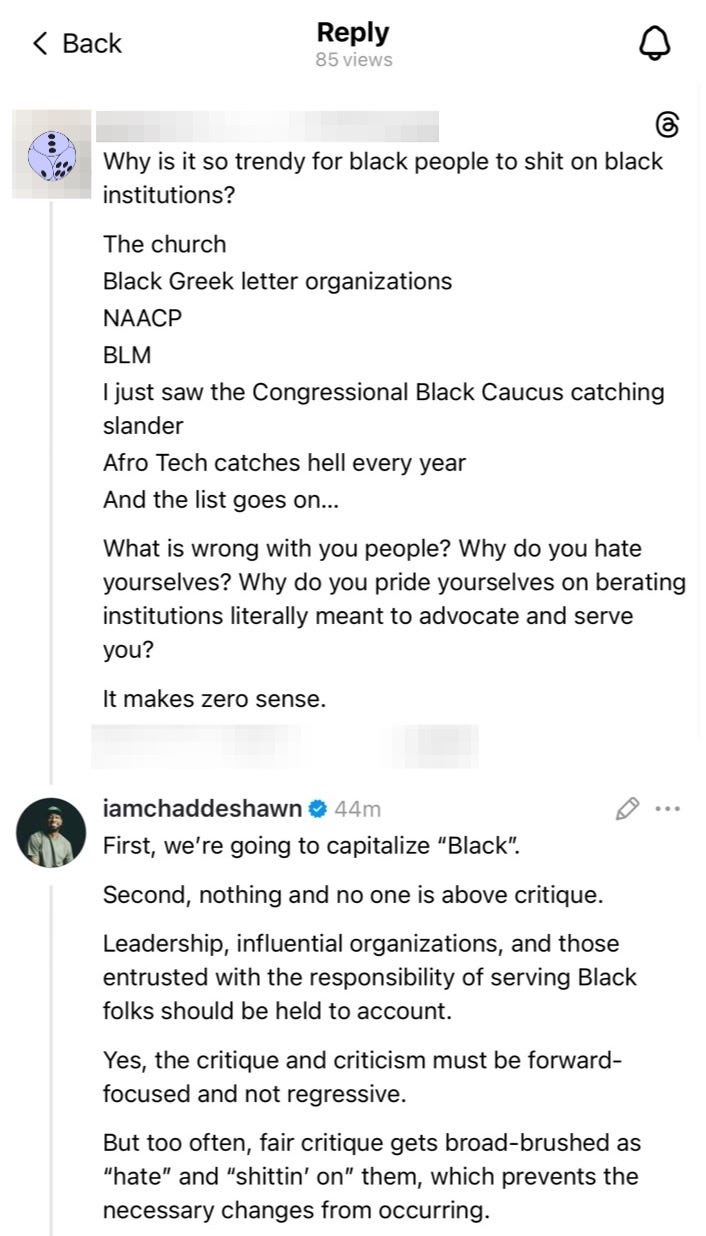
The accusation was familiar, even if the venue was new.
“Why is it so trendy for Black people to shit on Black institutions?” a Threads poster asked, before running down a list that read like a roll call of foundational Black American institutions: the church, Black Greek-letter organizations, the NAACP, Black Lives Matter, the Congressional Black Caucus, AfroTech. The conclusion came quickly and confidently.
Criticism wasn’t concern. It was self-hate. Proof that something was broken. Not in the institutions, but in us.
I sighed—my usual deep Negro sigh—and started typing: “Nothing and no one is above critique.” Especially institutions entrusted with the responsibility of serving Black people.
What followed mattered more than the exchange itself. The disagreement wasn’t really about whether any of these institutions had failed, drifted, or misaligned. That was secondary.
This was about whether accountability was permissible at all—whether naming problems constituted a special brand of Black betrayal, and whether unity had become a moral obligation that required collective silence.
For context, that framing isn’t new. But it is costly. And the people who pay that cost are rarely the ones being protected.
When accountability gets labeled “self-hate” it becomes an efficient way to end a conversation without addressing the topic at hand.
Critique gets reframed as betrayal. Valid questions become threats. And what should have triggered reflection and evaluation instead demands silence.
All in the name of Black Unity.
To widen the lens a bit, this isn’t new. These are old dance moves to a familiar track. Disagreement is moralized, and the person raising concerns is repositioned as the problem:
Here goes another Black mouth talking’ out of turn and messing’ up the church’s money.
The pushback lands in this awkward space. A place where the critique is confronted as being “wrong” or “untrue” but because it is inconvenient.
“Bad timing.”
“You’re airing our dirty laundry.”
”Why are you bringing this up now?”
This line of arguments misdirects and disarms the critique using timing as a moral checkpoint. But the result is not collective strength. It’s an intra-cultural face-off—one that allows institutions to pass through, unburdened by accountability while the consequences land like bricks on the people with the fewest alternatives.
We’ve seen this pattern before.
A few years ago, this surfaced when scrutiny began to surround the Black Lives Matter Global Network Foundation. As reporting raised questions about their finances, real estate purchases, and governance structure, much of the criticism came from Black journalists, organizers, and people who had been inside the actual work.
That context should have mattered. And for many, it did.
But it didn’t protect them.
Instead, the familiar charge was raised. Critics were accused of undermining the movement. Of doing the work of FOX News. Of betraying racial solidarity at a moment when Black political power was already under attack.
Almost overnight, the substance of the concerns became secondary to the voices that questioned:
“Who are you really working for?”
“Who’s paying you?”
”What are you getting for tearing down a Black organization?”.
What mattered more was the perceived disloyalty of the people voicing the concerns than the concerns themselves.
In fairness, that reaction rests on a widely held assumption: Black institutions must be protected at all costs because there are so few of them. And given a history shaped by exclusion and chronic underinvestment, the instinct makes sense. Black-led organizations are scrutinized more harshly, tasked with “doing more with less”, and forgiven less often than white ones.
Failure is rarely viewed through broader context. It’s treated as indicative of Black mismanagement and incompetence.
Against that backdrop, critique can feel dangerous—not just to an organization trying to save us while also trying to save themselves, but also to the idea of Black competence itself.
That duality forces hard choices. It reveals how Blackness is sometimes treated as a limited resource—one we’re taught to conserve by avoiding visible failure rather than confronting internal dysfunction.
But this “scarcity mindset” has consequences.
When institutions are treated primarily as symbols of collective Black survival, they stop being evaluated as institutions. They become monuments of resiliency rather than vehicles that move us forward. Performance questions give way to identity defense. The bar shifts from Is this working for us? to What does it say about us if this fails? And once that shift happens, accountability becomes almost impossible to raise without being interpreted as hostility.
And as the legendary Roots Crew would say, that’s where Things Fall Apart.
Accountability gets mislabeled as animus.
Motive replaces outcome.
And the fight turns inward.
Instead of interrogating leadership decisions, governance structures, or alignment with the goals of liberating Black folk, the conversation gets recentered around equity and fairness in a racist system. The familiar deflection—what about white institutions?—enters the room, and the much needed self-surgery stops.
Yes, the double standard is real. But using it to shut down self-evaluation is a fatal mistake.
This framing benefits specific people; even when it’s deployed with good intentions. Ineffective leaders gain insulation from scrutiny without having to demonstrate results. Reputation is inherited through community defense rather than something earned through performance. And those who enforce the “self-hate” charge gain moral standing as a social superhero—protecting Black unity while our institutions avoid meaningful evaluation.
What we allow matters as much as who we allow.
If institutions created to fight on behalf of Black people can’t withstand the critiques of the people it serves, then it’s not fit to serve us.
Because the attacks from the outside will be far less forgiving.
As was the case with BLM Global Network Foundation, former staff and chapter leaders later described internal concerns that had been raised and dismissed long before journalists started paying attention. Questions about finances and decision-making were framed as disruptive. Escalation was discouraged. Keeping quiet was treated as loyalty. And speaking up carried professional and reputational risk.
They weren’t being apathetic. And this wasn't ignorance. They were managing reputational risk inside a constrained—yet volatile—social ecosystem.
For people who depend on Black institutions for employment, access, services, or political leverage, criticism is not abstract.
It can cost relationships. Opportunities. And even safety. When alternatives are limited, silence becomes rational; even when that silence plays a major role in enabling dysfunction.
The costs aren’t theoretical, and they aren’t evenly shared.
And the likelihood of suffering these consequences solo can be extremely high.
When accountability is deferred, failure doesn’t disappear. It accumulates. Like a water leak behind a wall. Small problems that could have been addressed early compound into crises. And by the time attention is forced, the damage is broader and much deeper.
Local activists lose credibility. Struggling communities lose services. Trust in leadership erodes. And an entire ecosystem of Black and Black-serving institutions pays the price through reputational ruin, tighter funding, and heightened surveillance.
What gets framed as a sudden implosion is usually the result of long-ignored warnings.
And even then, the lesson rarely sticks.
The focus turns to managing fallout and controlling the narrative instead of interrogating the conditions that made the fallout inevitable. Early critics are blamed for being too loud—or too late—even when they were dismissed precisely because they spoke too soon.
But when we zoom out, a deeper irony comes into focus: suppression doesn’t prevent weaponization—it guarantees it.
When failures finally surface, hostile actors point back to earlier internal criticisms as proof that dysfunction was “always there.” The accountability once labeled self-hate gets stripped of nuance and redeployed without care.
The community loses control of the narrative because it avoided internal correction. We are accused of ignoring the warning signs, being incompetent, or labeled as opportunistic grifters hoping to make a few dollars.
The narrative from outside the Black community won’t perform the post-institution autopsy with a scalpel. They’re coming with a chainsaw and there will be no regard or care for preservation. The goal is to make a messy example of what’s left and charge us for the clean-up.
This is how institutions collapse—not through malice, but through an inability to tolerate feedback. The fall, when it comes, is heavier than it ever needed to be. And the people most harmed are rarely the ones who made the decisions. They’re the ones who depended on the institution to function. The ones who couldn’t exit. The ones left holding the consequences when the door finally gets kicked in.
The reframe is simple, even if it’s uncomfortable.
Accountability isn’t disloyalty; it’s an investment opportunity.
The burden shouldn’t fall on critics to stay quiet, but on institutions that claim legitimacy to demonstrate transparency, responsiveness, and a willingness to repair what’s broken.
Because unity that can’t survive scrutiny isn’t strength. And using strength to quiet scrutiny is an early sign of weakness.
If calling accountability “self-hate” remains the default, the pattern will hold. Critique will be policed. Institutions will be insulated. And failures will continue to compound.
And when the costs finally come due, they will be paid—again—by the people least able to absorb them.
If this essay resonated, consider subscribing to support independent writing like this. Substack allows me to publish work that isn’t influenced by clicks, institutions, or advertisers—just the world encountered through the lens of the Black experience.